Office Furniture Manufacturer vs Furniture Dealer: Which Is Better?
Choosing the right source for office furniture is an important decision for businesses planning a new office, expanding an existing workspace, or renovating their workplace.
When searching for office furniture, companies generally have two options: purchase directly from an office furniture manufacturer or buy through a furniture dealer.
Both options have their own advantages. A dealer may provide access to multiple brands and products, while a manufacturer can offer greater control over customization, specifications, production, and project execution.
So, which option is better?
The answer depends on your office size, budget, customization requirements, project timeline, and the type of furniture you need.
This guide compares an office furniture manufacturer and a furniture dealer to help businesses make an informed decision.
What Is an Office Furniture Manufacturer?
An office furniture manufacturer is a company that designs and produces furniture in its own manufacturing facility or through its controlled production process.
Manufacturers may produce products such as:
- Modular workstations
- Executive desks
- Office desks
- Conference tables
- Reception counters
- Storage cabinets
- Pedestals
- Office partitions
- Collaboration furniture
- Customized office furniture
Because the manufacturer is directly involved in production, businesses can usually communicate specifications and customization requirements directly with the production team.
What Is a Furniture Dealer?
A furniture dealer generally purchases furniture from manufacturers or brands and sells it to customers.
Dealers may offer products from several manufacturers, allowing customers to compare different brands and product categories from one place.
Depending on the dealer, services may include:
- Product selection
- Quotations
- Transportation
- Installation
- Basic project coordination
- After-sales assistance
However, the level of customization and technical control can vary depending on the dealer and the manufacturer behind the products.
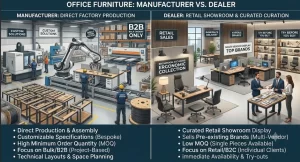
Office Furniture Manufacturer vs Furniture Dealer
The biggest difference is the role each one plays in the supply chain.
| Factor | Office Furniture Manufacturer | Furniture Dealer |
|---|---|---|
| Manufacturing | Direct production | Usually sources products |
| Customization | Generally high | Depends on manufacturer |
| Product specifications | Direct control | Depends on brand |
| Bulk orders | Highly suitable | Suitable |
| Design support | Often available | Varies |
| Pricing | Potentially more direct | May include dealer margin |
| Production control | Higher | Lower |
| Product range | Manufacturer’s range | Multiple brands possible |
| Installation | Often available | May be outsourced |
| Project coordination | Direct | Depends on dealer |
| Warranty | Manufacturer-backed | Depends on brand |
| Best suited for | Large/custom projects | Smaller/multi-brand purchases |
1. Pricing: Manufacturer vs Dealer
Price is one of the first factors companies consider when purchasing office furniture.
When buying directly from a manufacturer, there may be fewer intermediaries between the buyer and production facility.
A dealer, on the other hand, may purchase products from manufacturers and add a margin before selling them to the customer.
However, this does not mean that a manufacturer will always be cheaper.
The final price depends on:
- Material quality
- Furniture specifications
- Quantity
- Customization
- Hardware
- Finishes
- Transportation
- Installation
- Warranty
- Project complexity
Therefore, businesses should compare complete quotations rather than assuming that one option will automatically be cheaper.
What Should a Furniture Quotation Include?
A detailed quotation should mention:
- Product name
- Dimensions
- Quantity
- Material specifications
- Finish
- Hardware
- Accessories
- Transportation
- Installation
- Warranty
- Taxes
Comparing quotations line by line helps identify the actual value being offered.
2. Customization
Customization is one of the biggest advantages of working directly with a manufacturer.
Every office has different requirements. A company may need furniture according to:
- Specific room dimensions
- Employee seating capacity
- Department structure
- Brand colors
- Storage requirements
- Cable management
- Existing interiors
- Floor layout
A manufacturer may be able to modify dimensions, finishes, configurations, and other specifications according to the project.
A dealer can also arrange customized furniture in some cases, but the level of customization depends on the manufacturer or brands the dealer works with.
Winner for Customization: Manufacturer
For companies with specific design or functional requirements, a manufacturer is generally the more suitable option.
3. Product Quality and Specifications
When purchasing directly from a manufacturer, businesses can communicate directly about product construction and specifications.
For example, they can discuss:
- Board or panel specifications
- Hardware
- Edge banding
- Table structure
- Partition construction
- Drawer mechanisms
- Surface finishes
- Load requirements
With a dealer, the customer may need to depend on the product specifications provided by the brand or manufacturer.
This does not mean dealer-supplied furniture is necessarily lower quality. A good dealer can provide high-quality products from established manufacturers.
The important point is to verify exactly what you are purchasing.
4. Product Range
Furniture dealers can have an advantage when it comes to variety.
A dealer may offer products from several manufacturers, giving customers the opportunity to compare different:
- Brands
- Designs
- Price ranges
- Materials
- Furniture categories
A manufacturer generally focuses on its own product range.
However, manufacturers that provide complete office solutions may offer a wide selection of workstations, desks, conference tables, reception furniture, storage, and other products under one system.
Winner for Multi-Brand Variety: Dealer
Winner for Consistent Project Solution: Manufacturer
5. Large Office Projects
For a large corporate office, furniture procurement can involve hundreds of workstations, multiple cabins, meeting rooms, conference areas, reception furniture, storage, and collaboration spaces.
Such projects require:
- Accurate measurements
- Floor planning
- Product customization
- Bulk manufacturing
- Coordinated delivery
- Professional installation
- Project management
A direct relationship with a manufacturer can simplify communication and production coordination.
For large projects, companies should verify the manufacturer’s production capacity before placing an order.
Winner for Large Customized Projects: Manufacturer
6. Small Office Projects
For a small office requiring only a few desks and chairs, a furniture dealer can be a convenient option.
A dealer may provide access to ready-to-buy products without requiring a detailed manufacturing process.
This can be useful when the business needs:
- A few office desks
- Several chairs
- A small conference table
- Storage cabinets
- Ready-made furniture
Winner for Quick Small Purchases: Dealer
7. Delivery Timeline
Delivery time depends on whether furniture is ready-made or manufactured specifically for the customer.
Dealers may have certain ready-stock products that can be delivered quickly.
Customized furniture generally requires:
- Design approval
- Material selection
- Production
- Quality checking
- Transportation
- Installation
Therefore, companies with strict deadlines should discuss the delivery timeline before placing an order.
Neither manufacturers nor dealers automatically guarantee faster delivery. The actual timeline depends on the project and supplier’s capacity.
8. Installation Services
Installation is particularly important for modular office furniture.
A large workstation project may require:
- Workstation assembly
- Partition installation
- Cable management
- Storage installation
- Desk alignment
- Hardware fitting
Manufacturers that provide complete project solutions may have dedicated installation teams.
Dealers may also provide installation, but it may be handled by third-party teams.
Before purchasing, ask:
- Is installation included?
- Who will install the furniture?
- Is transportation included?
- What is the installation timeline?
- Who handles installation-related issues?
9. Warranty and After-Sales Service
Furniture is a long-term investment, so warranty and service should be evaluated before purchasing.
Ask about:
- Warranty duration
- Manufacturing defects
- Hardware warranty
- Replacement parts
- Repair support
- Service response time
When buying from a manufacturer, warranty support may be more direct because the company is responsible for the product.
When buying through a dealer, warranty claims may involve communication between the customer, dealer, and manufacturer.
However, an established dealer with strong after-sales support can also provide an excellent customer experience.
10. Design and Space Planning
Modern office furniture should be selected according to the office floor plan.
A professional furniture company may help with:
- Seating plans
- 2D layouts
- 3D visualization
- Workstation configurations
- Cabin planning
- Conference room planning
- Storage planning
This is particularly valuable for large offices where poor planning can result in wasted space or insufficient seating.
Before finalizing furniture, provide the supplier with accurate office measurements and floor plans.
When Should You Choose an Office Furniture Manufacturer?
A manufacturer may be a better choice when:
- You are setting up a large office
- You need customized furniture
- You require hundreds of workstations
- You want consistent furniture across departments
- You need project-based planning
- You require specific dimensions
- You need complete office furniture solutions
- You want direct communication with the production team
For corporate office projects, direct manufacturer coordination can simplify the procurement process.
When Should You Choose a Furniture Dealer?
A dealer may be more suitable when:
- You need a small quantity of furniture
- You want to compare multiple brands
- You need ready-stock products
- You want quick product selection
- You require standard furniture
- You are furnishing a small office
- You prefer a single marketplace for different brands
Dealers can be particularly useful for smaller purchases where extensive customization is not required.
Advantages of Buying Directly From a Manufacturer
Better Customization
Furniture can often be adapted to specific project requirements.
Direct Communication
You can communicate directly with the company responsible for production.
Bulk Manufacturing
Manufacturers can be better equipped to handle large quantities.
Consistent Quality
A single manufacturer can maintain consistency across a large furniture project.
Project-Based Solutions
Manufacturers can often combine multiple furniture categories into one complete solution.
Direct Technical Support
Questions about materials, construction, dimensions, and finishes can be addressed directly.
Advantages of Buying From a Furniture Dealer
More Product Choices
Dealers may offer products from multiple brands.
Convenient Product Comparison
Customers can compare different products in one place.
Ready-Stock Availability
Some dealers maintain inventory of standard furniture.
Suitable for Small Requirements
Small businesses may find dealers convenient for purchasing individual products.
Multiple Price Segments
Dealers can provide options across different brands and budgets.
Manufacturer vs Dealer: Which Is Better for Corporate Offices?
For a large corporate office, a manufacturer is often worth considering because the project may require customization, bulk production, coordinated installation, and consistent furniture design.
For example, a corporate project may require:
- 200 workstations
- 20 manager cabins
- Executive furniture
- Multiple conference rooms
- Reception furniture
- Storage systems
- Collaboration areas
Managing all these requirements through a single manufacturer can simplify coordination.
However, businesses should still compare manufacturers based on quality, experience, production capacity, pricing, delivery, installation, and service.
Manufacturer vs Dealer: Which Is Better for Startups?
Startups generally have different requirements.
A small startup with 10–20 employees may not need highly customized furniture. Ready-made products from a dealer can be practical.
However, a rapidly growing startup planning a larger office may benefit from modular furniture that can be expanded or reconfigured later.
The decision should therefore be based on expected growth, not just the current employee count.
How to Choose the Right Supplier
Whether you choose a manufacturer or dealer, evaluate the supplier carefully.
Check Experience
Review previous office projects and customer references.
Verify Product Quality
Ask for specifications and, where possible, inspect samples.
Compare Quotations
Compare materials, quantities, installation, warranty, and services.
Check Customization
Understand what can and cannot be customized.
Verify Delivery
Get a realistic written delivery schedule.
Confirm Installation
Understand who will install the furniture.
Review Warranty
Ask for written warranty terms.
Evaluate After-Sales Service
Find out how service requests and replacements are handled.
Questions to Ask Before Placing Your Order
Before finalizing your supplier, ask:
- Are you a manufacturer or dealer?
- Where is the furniture manufactured?
- Can you provide product specifications?
- Can dimensions be customized?
- Do you provide office layout planning?
- Can you handle bulk orders?
- What is the production timeline?
- What is the delivery timeline?
- Is installation included?
- What warranty do you provide?
- How is after-sales service handled?
- Can you provide references from previous projects?
The answers can help you determine whether the supplier is suitable for your project.
Final Comparison
| Requirement | Better Option |
|---|---|
| Large corporate office | Manufacturer |
| Customized furniture | Manufacturer |
| Bulk workstation order | Manufacturer |
| Complete office setup | Manufacturer |
| Direct production support | Manufacturer |
| Multiple brands | Dealer |
| Ready-stock furniture | Dealer |
| Small office purchase | Dealer |
| Quick standard furniture purchase | Dealer |
| Highly specialized requirements | Manufacturer |
Final Verdict
There is no universal answer to whether an office furniture manufacturer or furniture dealer is better.
If you need a small quantity of standard, ready-to-use furniture or want to compare multiple brands, a dealer can be a convenient choice.
If you are setting up a corporate office, need customized modular furniture, require bulk production, or want a complete office furniture solution, working directly with a manufacturer can offer greater control over specifications, customization, production, and project coordination.
The most important factor is not simply whether the supplier is a manufacturer or dealer. You should evaluate quality, experience, customization, pricing, manufacturing capacity, delivery, installation, warranty, and after-sales service before making the final decision.
A reliable furniture partner should understand your office requirements and provide a solution that balances functionality, employee comfort, aesthetics, durability, and budget.
Frequently Asked Questions
Is it cheaper to buy office furniture directly from a manufacturer?
It can be, particularly for large or customized orders, but pricing depends on materials, quantity, specifications, customization, transportation, installation, and other project costs. Always compare detailed quotations.
What is the main difference between a manufacturer and a furniture dealer?
A manufacturer is directly involved in producing the furniture, while a dealer generally purchases and resells furniture from manufacturers or brands.
Is a furniture dealer better for a small office?
A dealer can be convenient for small offices that need standard or ready-stock products and want to compare multiple brands.
Is a manufacturer better for a large office project?
A manufacturer can be a strong option for large projects requiring customized furniture, bulk production, consistent finishes, installation, and project coordination.
Can furniture dealers provide customized office furniture?
Yes, some dealers can arrange customized products through their manufacturing partners. The level of customization depends on the supplier and manufacturer.
What should I compare before buying office furniture?
Compare product quality, materials, dimensions, customization, pricing, installation, delivery, warranty, after-sales service, and supplier experience.
Should I choose a local office furniture manufacturer?
A local manufacturer can offer practical advantages such as easier site visits, communication, delivery coordination, and installation support. However, quality and project capability should remain the primary considerations.